Kindergarten Our Way

P1010509bThis year we “officially” start our homeschool journey as Ian begins Kindergarten.  We’re joining a local co-op, and it’s odd feeling like a rookie when in some ways we’ve been at this for a couple years.  Yet there’s definitely a difference now that he’s old enough to be in school. For the past few years we did school how we wanted, when we wanted, and if we wanted to skip it altogether, who cared? Whereas now there are expectations.  Still, I’m excited about this new season.  I love the pride I hear in his voice when he tells people he’s in Kindergarten.  For the last few years when people would ask him if he goes to preschool he would quietly answer, “We homeschool,” and I could tell he felt like it just didn’t count, even though most of our friends homeschool.  This “Kindergarten” label makes him feel like he has joined the ranks of all the big kids in his life.

If anyone were to glance at our lesson plans, however, they would probably be a bit surprised, as they look rather different from what most people think of as Kindergarten.  I’m not a big fan of traditional curriculum.  Philosophically I tend to lean more toward a Charlotte Mason approach of using living books and narration (though I’m not a diehard CM follower who quotes her books chapter and verse).  Also, I can’t follow a curriculum to save my life.  I’m constantly tweaking and adapting things to suit our needs, and so I just couldn’t justify spending a lot of money on a well thought out curriculum that’s only going to really be used as a reference.  I’m about 80% sure that I’m going to use Ambleside Online as our core starting in 1st grade.  (My only hesitancy is that I’m considering putting together our own 4-year history cycle rather than AO’s 6-year cycle and doing that subject all together as a family.)  So I wanted to model our Kindergarten plans after what we’ll be doing once we start AO’s Year 1 next year.

The wonderful advisory board at AO has provided a list of quality books to use before children start Year 1 (they call it Year 0), but that wasn’t going to suit our needs for Kindergarten for a few reasons.  First and foremost, we’ve already read most of them many times over the last few years.  Not that it’s bad to repeat quality literature, but it really wouldn’t help Ian feel like he had had moved on to the next stage of life if we just kept reading the same stories.  Also, he’ll be turning 6 mid-year, and I feel like he’s ready to handle a little more structure.  So we’ll be doing what many refer to as a “Year 0.5,” which I’ve tried to design to be similar to Year 1 as far as subject matter, lesson length, and frequency.  (There’s no official list for Year 0.5, but many families have put together similar plans and posted them.

We started school this past week.  (Many schools in our area are year-round and begin in July. Plus I plan to take at least a month off after our baby arrives in September and I wanted to establish some habits before then.)  I was surprised at how smoothly our transition went.  We haven’t done any math since before we moved (months ago!), and even then we usually only did one or two lessons a week.  We’ve also been working on learning to form letters, but only doing it about once a week.  So it was a bit of a shift for Ian being asked to do these things every day (except Wednesday, when we go to the park with other families from our co-op).  By the third day, however, he didn’t question it at all, just sat down and did it.  He even seemed to enjoy the feeling of accomplishment he got when he’d completed his work.  Most of what we do, however, is reading aloud.  I’m starting to introduce him to Charlotte Mason’s method of narration, but not pressuring him on it.  After he turns six I’ll probably start to ask a little more of him.  For right now I’m just asking him to tell the story back to me when we’ve done a reading that seems fairly straightforward (and prompting him more than Charlotte Mason purists would approve).

To help me keep straight what I want to accomplish through the week, I wrote up a chart listing the subjects and what I want to do for each day.  I check them off as we go, and often we’re not done until dinnertime because we don’t ever sit down to get it all done in one chunk.  I try to let him play through as much of the day as possible, but if he asks to watch a show or seems to need something to do, then I offer to read to him or have him sit down to do his copywork or engage in a math activity.  The chart will be a work in progress (I already tweaked it a few times as we went through the week), but I think it’s going to be a good way for me to keep organized.  Here’s a picture of my marked up copy from this week, and here’s the actual document (HTS Kindergarten Chart updated) if you want to create something similar to use for your own family without starting from scratch.

P1010555

My plan is to keep these marked up charts for my records.  Across the top I’ll be keeping an ongoing count of how many days we’ve “done” school.  I’m not legally required to keep any records this year since Kindergarten isn’t mandatory in our state, but I want to have an idea of how we match up with the legal requirements so I’ll know if I need to make any changes for next year.

If you’re interested in what resources we’re using this year, I’ve listed them by subject below.  Many of the books I chose are part of the Yesterday’s Classics e-book package (225 books for $99.95, but often on sale for $49.95), but many others are available free for Kindle.  Here’s our (slightly daunting) list of books and other resources (edited over Christmas break):

Bible:

Copywork: finish learning letters.  Start Bible verses.

Writing: (Start 2nd term) Journal pages (color a picture, write a sentence about it). Relate to other parts of curriculum, field trips if he can’t think of what to write about.

Reading Instruction:

Math: MEP Year 1, Miquon (see this post for more)

Science/Technology/Nature Study:

Literature:

  • Classics: Fairy Tales (from Andrew Lang’s color books–not Red and Blue since they’re in AO-Year 1, recommended Uncle Remus stories)
  • Poetry: The Rooster Crows; Mother Goose; A Child’s Own Book of Verse, Book Two (After starting Book One, I realized most of it consists of nursery rhymes and traditional verses that were included in the other books we were using, whereas Book Two has longer, less familiar poems.)
  • “Free Reads”:

History/Geography

Fine Arts:

  • Music Appreciation (Ambleside Online: 1 folk song, hymn each term)
  • Piano Instruction: finish Yamaha Junior Music Course, then either the next Yamaha course or private lessons at home with mom
  • Composer Study (AO schedule: 1 each term)
  • Art Instruction: Five in a Row lessons, finish My First Book of Drawing from Kumon, start ARTistic Pursuits K-3 Book One The Way They See It – ARTistic Pursuits Preschool.  (I have been eyeing the books from ARTistic Pursuits for a couple years, but Ian is so artistically challenged I hesitated to even buy the preschool book up until now.  I thought we’d be okay jumping in with the K-3 series, but after looking through it I decided to save it for later and go ahead with the preschool book so we can hopefully include Elijah as well,.)
  • Artist Study (AO schedule: 1 each term)

Foreign Language (start 2nd term): Salsa Spanish (3 weeks per episode) Unit 1 (Episodes 101-106) (lesson plan materials from Wyoming Department of Education)

Physical Education: Family Time Fitness

It sounds like a TON of work for a Kindergartener, I know, but it’s actually not that bad.  Most of it just means being intentional about what I choose to read aloud (and there’s still plenty of time to read his choices as well–right now he’s really into The Littles series by John Peterson, currently on Book 3).  There are a lot of books listed here, but most of them we’re only reading a couple pages from each week.  (He often wanted to keep going, but with the exception of The Japanese Twins I didn’t give in.  I’d like to keep him wanting more!)  Also, many are available as free audiobooks (booksshouldbefree.com), and Ian often requests them in the car or at bedtime (especially fairy tales).

And just as a final note, this is NOT a plan I will be attempting to follow with my younger children when they’re in Kindergarten.  They can listen in on things like science, history and literature and won’t need their own books assigned for those.  It’s just that as the oldest Ian doesn’t get a chance to benefit from hearing older siblings’ lessons, so this is my way of exposing him to things he wouldn’t have a chance to catch otherwise.  I’m not chained to this “curriculum” I’ve put together.  We’ll be flexible.  Some we’ll get to; some we won’t.  I’m not overly concerned with what Ian achieves academically at this point in his life.  But if I didn’t have some sort of plan we wouldn’t be accomplishing much of anything, so at least this gives me something to look at, something to shoot for.

Happy Back-to-School!

Homeschool P.E. (Family Time Fitness)

100_4037

Ian at 19 months

Okay, so just typing that title gets all sorts of thoughts running through my head.  Let’s face it, I am not the poster child for physical fitness.  However, I know how important it is for kids, especially for my active boys (though I’m sure as Arianna gets a little older it will become equally important for her).  Ian in particular has always been quick to catch onto physical skills and eager to master them.  So as I started looking at all the books and curriculum I had chosen for Ian’s Kindergarten year and writing up a weekly schedule of how I want to fit it all in, I really felt like I needed to include time for Physical Education.  P.E. was my nemesis all through school.  It was the one subject I struggled to keep an A in, and that drove this little perfectionist crazy.  So whereas most of the subjects I plan for our school bring me absolute delight, this was one I just didn’t know how I was going to teach properly.

And I do think there’s something to be taught.  It’s so easy to pass off general physical activity as “P.E.”  There are a lot of reasons I don’t want to enroll my little ones in organized sports (at least at this point in time), which left me feeling rather lost.  I searched online for a list of skills I could use (skipping, galloping, balancing, throwing a ball, etc.) and maybe develop lessons around, though it seemed like a lot of work to put together anything of value.  Then I remembered that when I taught 2nd grade a few years ago, one of my colleagues had found a wonderful P.E. curriculum that taught basic physical skills and had fun activities.  (I think it was Ready-to-Use P.E. Activities for Grades K-2).  It was so helpful in providing actual lessons that were well thought out and fun for the students.  I considered purchasing it for our homeschool, but I was afraid too many activities would be geared toward larger groups of children.

Fitness 4 Homeschool Logo

Then I stumbled upon Family Time Fitness.  They have a program designed specifically for homeschool families.  They had a bunch of wonderful reviews on their website, but I wanted some more objective opinions.  I did a little research, reading reviews from families that had used it and blogged about it.  Everyone was so positive about this program that I decided to give it a try.  I loved that people said it worked for a wide range of ages in their family (and that it helped mom get in shape too, which I’m going to need after this baby arrives!)  I also liked that it’s a one-time cost of $57 per family rather than something I have to renew or purchase for each child.

I almost bought the Fitness 4 Home School Physical Education Core 1 immediately, but I decided to see if I could find a discount anywhere.  Sure enough, the Homeschool Buyers Co-op was just opening a “group buy” on the curriculum.  Woohoo!  I considered just purchasing at the current discounted price ($47), but then I convinced myself to be patient and commit to a lower price, which means waiting to see if enough people order to get an even deeper discount.  I’m hoping they will, but if not, I’ll just purchase it before the group-buy ends (9-2-13).

If you’ve wanted to include P.E. in your homeschool plans but struggled like me, I’d encourage you to check it out! You can even sign up for a free trial.  I can’t believe I’m actually excited about doing P.E. with my kids!


Long Story Short: The Tabernacle

I was kind of surprised when I realized we were going to spend a whole week on the Tabernacle as we journeyed through the Bible with Long Story Short by Marty Machowski.  However, as we went through the five days of devotions (plus one reading the story in The Gospel Story Bible, also by Machowski) I realized what an important concept it is to understanding the Old Testament.  The Tabernacle was God’s dwelling place among His people, a foreshadowing of Jesus as Immanuel, “God with us.”  Sure, He had interacted with individuals before, and He had shown His power to the people through the plagues in Egypt, the parting of the Red Sea, and His provision for them in the desert, but this was more than that.  This was His actual Presence being with them.  What a powerful thing!  Imagine living in the camp of the Israelites and seeing God’s magnificent tent there in the midst of the thousands of other tents that housed the people, knowing that the almighty Creator of the universe was dwelling there with you.

This week’s devotions probably would have been really hard to get through without the use of visual aids.  If the kids were a little older, I would have been tempted to buy a model of the Tabernacle to put together, but instead I decided to get a Tabernacle felt set for our flannel board.  Unfortunately, one piece was too big for our boards!  So we headed off to the fabric store for some black flannel and made our own big board.  It ended up working out well because we could have two boards out, for both the outer courtyard and the inside of the tabernacle.

P1010515

The other resource we used, which I highly recommend, is the Rose Guide to the Tabernacle.  It is not a children’s book, but it is a wonderful resource for personal study, and there are many pictures that are helpful explaining this passage of Scripture to children (or anyone!). We used the felt pieces and/or the Rose Guide every night.  It was so beneficial for the boys to have something tangible to hold and look at as we read through long descriptive passages of the tabernacle and the high priest’s garments that might otherwise have been hard-pressed to hold their attention.

I didn’t have the energy to come up with anything elaborate for the boys’ Bible notebook pages, so I printed up dot-to-dot on a page with our Bible verse.  (Note I did not say memory verse.  We’re not that together yet!  I really want to get back to memorizing Scripture with the boys, but I’m considering going a new route, not connected to our Bible stories, and we’re not up and running.)  However, the week flew by without us ever doing the page.  Will we ever get to it?  I’d give it a 50/50 chance.  I’m trying to let things go and just move on.

Long Story Short: The 10 Commandments

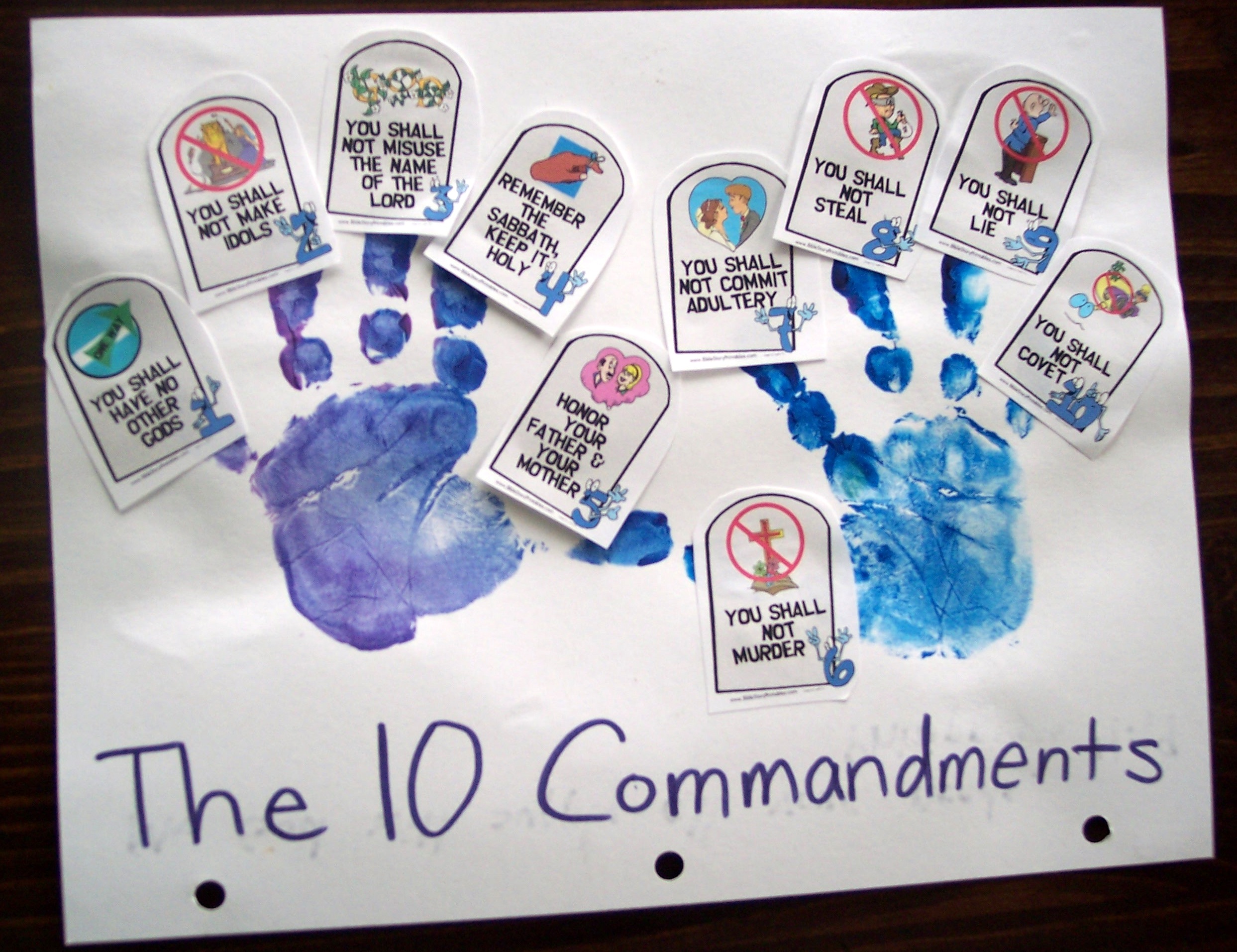
We just finished up a great week (plus a few extra days!) on the Ten Commandments.  Even Elijah (3 1/2) worked diligently toward memorizing them, and both boys enjoyed the various activities we did throughout the week in addition to our nightly Bible Time with Long Story Short by Marty Machowski.  We broke out our flannel board set for the first time since our move, and all three kids enjoyed playing with it throughout the week.  I’ve put it on a low table in our schoolroom where they can all reach it, and pretty much every day I caught a glimpse of at least one of them acting out the story with the little felt figures.  (Okay, so Arianna just liked collecting the people and carrying them around, but she’ll get there.)

I really considered buying a 10 Commandments Project Pack from CurrClick, but since I only planned on spending a week on the topic I decided to just stick with activities I could find for free online.  BibleStoryPrintables.com has a lot of fun ideas to print (and in our case laminate so I can reuse them with the younger children).  I pretty much stuck with printables from their site so that the wording would be the same on all our activities.  I used the bookmarks as a reading tool.  They print four on a page, so I printed out one set and laminated them.  Every day at lunch time, each of us got one (even Arianna) and we read through them together.  We worked on memorizing two commandments each day.

I also printed out the sequencing cards and number cards for a matching activity.  (There’s a typo on “adultery,” but I just used a black marker to fix it.) The boys really liked using our pocket chart to have the cards all out in front of them.  We just worked on putting them in order and matching the pictures with the written commandments, but they’d also be great for playing a memory matching game.

P1010481   P1010492

The last thing I printed out was the file folder game.  The game board has typos on “misuse” and “adultery”, but it was pretty simple to fix them by opening the image in Paint, cutting and pasting the letters into the correct places, then copying the corrected image into Word.  (I also found a second game  from The Catholic Toolbox, but I’m saving that one for when my kids are a bit older.)  Next time maybe I’ll plan ahead more and use some of the activities from Oriental Trading Company related to the ten commandments.

After several months’ hiatus, we finally added a page to the boys’ Bible notebooks.  I looked for a new idea, but I just couldn’t find anything I liked as much as the one I did with Ian two years ago (see my post “Train Up a Child (10 Commandments pt.2)) so we just did it again.  I forgot Elijah’s not a big fan of finger painting, however, so we barely got this one out of him.  He does really like numbers and putting things in order, so after the first day he enjoyed pasting on the commandments.

P1010486   Ten Commandments 2

Each day we watched one of the episodes from the Kids’ Ten Commandments DVDs.  (There are five episodes, each covering two commandments, so it worked perfectly with our schedule.)  The boys REALLY liked these videos.  They do a wonderful job illustrating each of the commandments through a story about a young Israelite boy living in the desert.  Highly recommended!

Our “Listening Lesson”

Long Story Short: Moses

I hesitated to even write this post, since we did very little during our study of Moses from birth through the Exodus outside of reading each night from Long Story Short or The Gospel Story Bible by Marty Machowski.  This season reinforced how much I appreciate the depth of these resources.  Machowski points out both the obvious and more subtle connections of the Old Testament stories to Jesus, and he presents them in such a way that even my boys, only 3 and 5, are able to understand and articulate.

The reason I did decided to go ahead and do a short post about the several weeks we spent on this section of Exodus is that I want to keep a record of the resources I’ve come across.  Because we were caught up in the chaos of packing, moving, and settling in, we pretty much just stuck with picture books and videos to supplement our Bible Time reading every night.  So here are my lists, plain and simple:

Picture Books

Videos

We finally got back to our “Listening Lesson” during Week 33 “God Provides Food and Water for Israel.”  Here’s what was on our playlist:

Follow the Drinking Gourd

We stumbled into our latest Five in a Row book completely by accident.  I really wasn’t planning to do any formal schoolwork for a while, but as I started to get boxes unpacked, Ian was drawn to the series of ValueTales books from my childhood library.  He picked out The Value of Helping about Harriet Tubman one night to read with Daddy before bed, so the next day as I was searching for some sort of educational video to put on while I continued tackling boxes, I decided to put on the Reading Rainbow episode on the book Follow the Drinking Gourd by Jeanette Winter.  I figured it was a good time to discuss the concept of slavery and the Underground Railroad since the book on Harriet Tubman had already introduced the idea.  (It also just happened to fit in with our Bible lessons on the Israelites being freed from slavery in Egypt.)

We did several of the lessons from the Five in a Row manual (Vol. 2).  The ones the really stood out were searching for compound words (which took Ian longer than I expected to catch on to, but was really helpful because we started finding them all over the place after that) and learning the song.  Ian enjoyed listening to me sing it as I played it on the piano (so glad the music was in the back of the book!), but I also found a great video of the song on YouTube which shows the lyrics while playing the music.

We talked about gourds and how they can be used to hold liquids.  I have a calabash, or “bottle gourd” that some Maasai friends gave me when I lived in Kenya, and Ian enjoyed having something he could hold and look at, even if it’s shaped a little differently than the drinking gourd referred to in the song (which I would imagine looks more like the picture on the right).

P1010473  

I found a number of other videos that went along well with this study.  The first was Harriet Tubman from the Animated Hero Classics series (also available on YouTube).  The other was video Follow the Drinking Gourd starring Morgan Freeman, which is available streaming free for Amazon Prime members (anyone can do a 7-day rental for $2.99).  It tells the story of a family escaping via the Underground Railroad.  (For older students, check out Whispers of Angels: A Story of the Underground Railroad, also available streaming free for Amazon Prime members. It’s about an hour long, and it’s a documentary rather than a story, but I really enjoyed it.   Harriet Tubman and the Underground Railroad is another option.  It was a little “dry” for Ian, but short and very informative.)

So it was a pretty simple “row,” but Ian learned a lot, and it felt good to get back into Five in a Row!

To see what other FIAR books we’ve rowed, see my “Index of FIAR Posts.”  Also, a great place to see what other people have done with FIAR books is the FIAR Blog Roll at Delightful Learning.

Reflections on Moving While Homeschooling Little Ones

Whew! The last few months have been rather crazy as we looked for a new home, prepared to move, and then managed to get everything into the new house. Little did I realize the chaos had only just begun. We’ve been in our new house for just over a month, and I’m just barely feeling like things are beginning to seem “settled.” After weeks of hassle (including numerous phone calls and several visits by technicians), we have Internet access AT LAST, so while the little ones are napping (or trying to, anyway), I thought I’d take the time to come back the blog and bring it up to date (well, sort of).

There are so many ways God blessed us by providing this home, but one of my favorites is the opportunity to have a designated “schoolroom.”  It may not look like much in these pictures, but you should have seen it 4 weeks ago when we were maneuvering through a maze of boxes filled with books I haven’t had the space to unload since I was a classroom teacher!  I’m so excited to have a place not only for all those books (believe it or not, I’ve thinned out my library several times in the last couple years, giving away BOXES full of books) but also for things like math manipulatives, games, puzzles, etc. that all make up part of our homeschool lifestyle.

P1010468

P1010470

I’m hoping to get this room “finished” and in good working order over the summer (just in time for our new baby to come and bring complete chaos back into our lives).

There are a couple things I wish had gone differently through the course of our move (at least as far as homeschooling), though most (like the lack of Internet access) were beyond my control.

  • We temporarily lost our copy of Long Story Short by Marty Machowski, the foundation of our Bible lessons and family devotions. The box it ended up in was filled with things packed at the last minute, got labeled (not very specifically) only on the bottom, and ended up in our shed surrounded by car parts.  After a few weeks I finally ended buying a Kindle version of the book (since I figured that could come in handy when we’re away from home), and then a few days later Eric stumbled across the right box as he was trying to bring some organization to the shed.  We really missed our Bible Time as a family in the evenings, and have still not fully gotten back into the habit, though we’re making progress.
  • We’ve gone about 2 months now with no new listening lessons or audiobooks, which has been a challenge since they usually play a big part in our schoolday.  Shortly before we moved, my antivirus program started causing issues with iTunes (as in wiping out my entire library).  I spent a few hours restoring everything and trying to set up some “listening lessons” to get us through the weeks ahead, only to have all my work disappear two more times.  I finally had to give up because there were so many other things needing to be done.  Now that we’re getting settled in and can access the Internet, I’m hoping to tackle the task of getting everything back in working order within the next week or two.
  • Unfortunately, even once I get all my files back in order, I still will have to figure out how to make Listening Lessons a regular part of our day.  We no longer have a 30-minute drive to church and other activities, which made up a big chunk of our listening time.  And to make thing more complicated, my main iPod dock/speaker isn’t working since the move.  The boys still listen to stories in their room at naptime/bedtime, but we have no way of listening out in the main part of the house unless I feel like moving a dock around several times a day.

For the most part, however, I’m pretty satisfied with where things stand as far as homeschooling.  In a way, the move has helped me mentally prepare for the way a newborn is going to affect my ability to start do schoolwork with Ian, and I’m thankful that I’ve been able to develop a more realistic idea of how a major change is going to demand flexibility.  I knew we’d be taking some time off from organized schoolwork during this season, but I had no idea how much of a break we would need.  I think there was a solid three-week period (mostly leading up to Moving Day) in which we didn’t do a single thing unless you want to count educational videos. We spent a lot of time with  The Magic School Bus, Reading Rainbow, and the Scholastic Storybook Treasures collections.  (The boys enjoyed the first collection of 100 Storybook Classics so much, a bonus from Grandma’s retirement from teaching Kindergarten, that we got Ian the second collection for his birthday. LOVE these!)

Once we had moved, it was easier to start easing our way back into things.  I started making a routine of having Ian read to me every day.  Even if we did nothing else, that at least helped me feel like we were getting back into the groove of school.  Last week we started back up with learning how to write the letters of the alphabet correctly.  I don’t have Ian do this every day (it’s challenging for him, but I’ve decided to go ahead because he really wants to be able to write), but we’re adding it to our routine. We’re back into our Bible lessons on Moses, and we’ve even have done spent some time with Five in a Row books (posts coming soon), so except for math and composer study, I’d say we’re almost back to school as it was before the move.

One nice new addition has been doing a LOT of reading aloud from chapter books.  I started with Ramona the Pest by Beverly Cleary because I thought Ian would enjoy hearing about a Kindergarten experience, and he enjoyed it so much we read through all of the Ramona books in less than two weeks.  He then wanted to start in on the Henry Huggins series (also by Beverly Cleary) but I decided to save those for later and instead we’ve started reading through the “Little House” books by Laura Ingalls Wilder.  I’m glad he’s enjoying some of my favorite childhood books, and all the reading had provided a nice break from unpacking boxes.  (My other favorite reason for avoiding them has been to take the kids to the beautiful park just down the street.  We’ve gone 2-3 times each week, and it’s going to be the main source of our nature study once I’m ready to add that back in to our studies.)

I’m so thankful Ian’s not officially in Kindergarten yet, because moving with 3 young children (with a fourth growing in my womb and sapping a lot of my energy!) requires all the grace one can give oneself, and I would have been incredibly stressed if I had any academic requirements hanging over my head.  We’ll probably postpone starting our school year until close to November, though we’ll keep doing what we’ve been doing until the baby arrives at the end of September.  It feels good to be getting back to normal!

Very Last First Time

The other day Ian was watching an episode of Reading Rainbow (Keep the Lights Burning, Abbie), and one of the books they recommended at the end was Very Last First Time by Jan Andrews.  He came to me asking if we could get that book, and I told him we already have it since it’s one of our Five in a Row books.  It has been a few weeks since we rowed anything, so it was a great impetus for getting us back into FIAR mode.   I wasn’t familiar with it yet, but it turns out that this is a fascinating book! We pulled out our Five in a Row manual (Vol. 1) and both enjoyed finding out more about the Inuit culture during our week with Very Last First Time.

Ian was puzzled by the airplane in some of the pictures.  “Did they have airplanes in the old days?”  I agreed with him that many parts of the story seemed to indicate it was set a long time ago, but then I pointed out that Eva’s kitchen looks pretty modern.  However, we were a little uncertain as to exactly when to place it because they did use candles for light rather than flashlights (or headlamps, like in the amazing video we watched of real mussel hunters going under the ice).  I wasn’t as concerned about settling on an exact year so much as helping Ian look for clues as to the time period.

P1010214I used this as an opportunity to teach Ian a little about Canada.  After finding the country on our map, we searched for Ungava Bay and talked about what “tundra” means and how the climate is different from where we live because of how far north it is.  We also searched through our collection of foreign coins for any from Canada.

We didn’t spend a whole lot of time on Inuit Culture, but we did get a little taste of it.   It just so happens that we’ve been reading through The Eskimo Twins by Lucy Fitch Perkins as our chapter book read-aloud lately, it was a good fit.  (This link is to a free Kindle version, but we really enjoyed the illustrated version that came in our set of e-books from Yesterday’s Classics.  So many wonderful books are in this bundle!) We watched a video on how to build an igloo, which Ian wanted to share with everyone who came to our house.  P1010286He spent a little time working on this igloo coloring sheet for sight word practice.  I hesitated first about printing it out, and then about giving it to Ian, but it turned out to be a good exercise in following directions and working independently.  He did as much as we wanted and I decided to just leave it at that.  We also read three other picture books that were related to Inuit culture: On Mother’s Lap by Ann Herbert Scott; Mama, Do You Love Me? by Barbara Joosse; and The Three Snow Bears by Jan Brett.


I’m not sure what it was that made Ian want to read this book when he saw it introduced on Reading Rainbow, but I was glad that we had it on hand so we could pull it out when he asked for it.  I first discovered Five in a Row when he was not quite two years old.  Right away I knew it was something I wanted to do, so I started collecting the books from Before Five in a Row and all four volumes when I’d see them at used book stores and on PaperBack Swap.  By the time Ian was old enough, I’d gathered probably ninety percent of the stories.  It’s wonderful being able to just grab one that interests us and dive in!

To see what other FIAR books we’ve rowed, see my “Index of FIAR Posts.”  Also, a great place to see what other people have done with FIAR books is the FIAR Blog Roll at Delightful Learning.

Composer Study: Piotr Ilyich Tchaikovsky

When I was a little girl, I was obsessed with ballet.  One of the first cassettes I ever remember purchasing was music from Tchaikovsky’s three ballets: Swan Lake, Sleeping Beauty, and Nutcracker.  Even people without a connection to ballet are probably familiar with these musical works, but they were a part of my very being.  In my piano lessons I worked harder on Tchaikovsky pieces than anything else, just because he had composed those three ballets.   I no longer eat, sleep, and breathe all things ballet, but even so, there is something magical for me about this music, so I really enjoyed our composer study this past month on Piotr (Peter) Illyich Tchaikovsky.

Audio Resources

Tchaikovsky wrote a lot more than just ballet music, so we had plenty of listening options this month.  The boys were already familiar with a lot of his music from Nutcracker, so we mostly focused on the 1812 overture (what boy wouldn’t love the idea of a cannon being fired as part of an orchestral piece?) and the music from Swan Lake.  Here’s what was on our composer playlist for the month:

Video Resources  

As usual, the boys knew many of the themes we were listening to from watching Little Einsteins episodes that feature music by Tchaikovsky:

The boys loved watching the part of Fantasia that contains the Nutcracker Suite, and we were all amazed by a YouTube video of the Great Chinese State Circus doing a scene from Swan Lake (not pure ballet, but SO worth watching just to see the main dancer’s incredible balance).  Ian also enjoyed watching an entire performance(in two sittings) put on by the Kirov Ballet.

Books

To help Ian understand what we were watching and listening to, I got a copy of Margot Fonteyn’s retelling of Swan Lake.  The illustrations are by Trina Schart Hyman (who also illustrated the Caldecott award-winning St. George and the Dragon, one of the boys’ favorite books).  He loved this book and brought it to me to read over and over throughout the month.  We also read Tchaikovsky Discovers America, which tells the same story as the Classical Kids CD from a different perspective.

Once again, a month flew by and we were saying good-bye to Tchaikovsky just as we felt like we were starting to get to know him.  We’re getting ready to move so we’ll be taking a break.  I think we’ll use this next month or so to go back and revisit some of the composers we’ve already learned about.

Long Story Short: summary of our weeks on Joseph

Contrary to what my recent blogging record implies, we’ve been plugging away at our Bible lessons as usual.  I continue to be so thankful for Marty Machowski’s Long Story Short.  During a season of minimal schooling, I am confident our children are still getting a steady diet of Bible knowledge thanks to the thoughtful devotions in this book.  I haven’t been doing a lot of extras, just our nightly devotions and a “listening lesson” for during the day, which we primarily use as we drive around town.  Even so, as we’ve gone through the last few weeks on the story of Joseph’s life, both boys have learned a lot, and Ian especially has it firmly engraved upon his heart.

The more we read about Joseph, the more in awe I am of how God works in our lives.  It really is an incredible story.  God took something horrible (broken family relationships, near murder, selling a brother into slavery and deceiving their father) and used it to save countless lives during the famine that came years later.  And one of the pivotal events of the Bible, the Exodus, wouldn’t have happened Joseph (and later his family) hadn’t gone down to Egypt.

The story lends itself to so many discussions, and we often used our extra night (the book includes 5 devotions each week, plus we do one night in The Gospel Story Bible, also by Machowski) to read through what the Bible said about pride, trust, forgiveness, etc.  I used Parenting With Scripture to easily look up verses on each topic, but a Child Training Bible would also be a good tool.  (I just didn’t want to take the time to flip through all the verses to pick out which ones to read with the boys, so Parenting With Scripture was handy because the verses were all laid out on one page.)

Go-Along Books The story of Joseph is found in most children’s Bible storybooks.  We read it in several over the weeks we spent on the story, but I also really liked this book: Joseph by Brian Wildsmith.  It is a thorough retelling of the story, accompanied by beautiful illustrations.  Ian especially liked the hieroglyphics (thank you, Little Einsteins, for introducing them!)

Bible Notebook I have to admit, we haven’t been working on a memory verse, but we did talk about Romans 8:28 so I put it on our Bible notebook page so the boys could review it whenever they look through their books.  For the craft, I considered repeating what we did the last time Ian and I talked about Joseph, but I didn’t want both his notebook pages to be the same.  Instead I just had them color on coffee filters and then use an eyedropper of water to help the colors spread out.  We cut out two wedges for the arms and then bunched the rest up for the coat and glued them on top of people we drew.  Ian thinks they look like dresses.  I have to agree.   At least they’re colorful!

P1010141

Multimedia

We watched several related videos over the course of our study:

  • Joseph: King of Dreams DreamWorks took a few liberties with the story (mostly about the timing of Rachel’s death, how long Joseph was in prison, etc.), but overall our whole family enjoyed watching this together and comparing it to the biblical account.
  • Joseph and the Amazing Technicolor Dreamcoat While the cover of the DVD touts it as the “classic family musical,” THIS IS ONE TO KEEP THE REMOTE HANDY ON!  We completely skipped the scene with Potiphar’s wife because the costumes were so inappropriate.  There were a few other scenes that had some questionable costuming as well but I let them pass because it wasn’t as obvious and Ian didn’t seem to notice.  It’s really too bad, because the music itself is very family friendly (with the exception of Potiphar’s wife saying, “Come and lie with me, love,” but since that’s pretty much what the Bible records, I’m not going to complain).
  • Veggie Tales: The Ballad of Little Joe Ian has seen this one before, but I don’t think he’d ever realized it’s (loosely!) based on the story of Joseph.  This time he definitely caught the similarities.

I had so many things to use in our “Listening Lessons” to go with Joseph.  I broke it down and tried to only use the ones that specifically applied to the part of the story we were focused on each week.  Here’s a summary of all the things we listened to:

Ian and I closed out our time on Joseph by going to a live theater performance of Joseph and the Amazing Technicolor Dreamcoat (one we had been assured was appropriate for kids).  It’s a fast-paced show, so it kept his attention the whole time.  We really enjoyed our special “date” together! Oh well.

P1010134

« Older Entries Recent Entries »