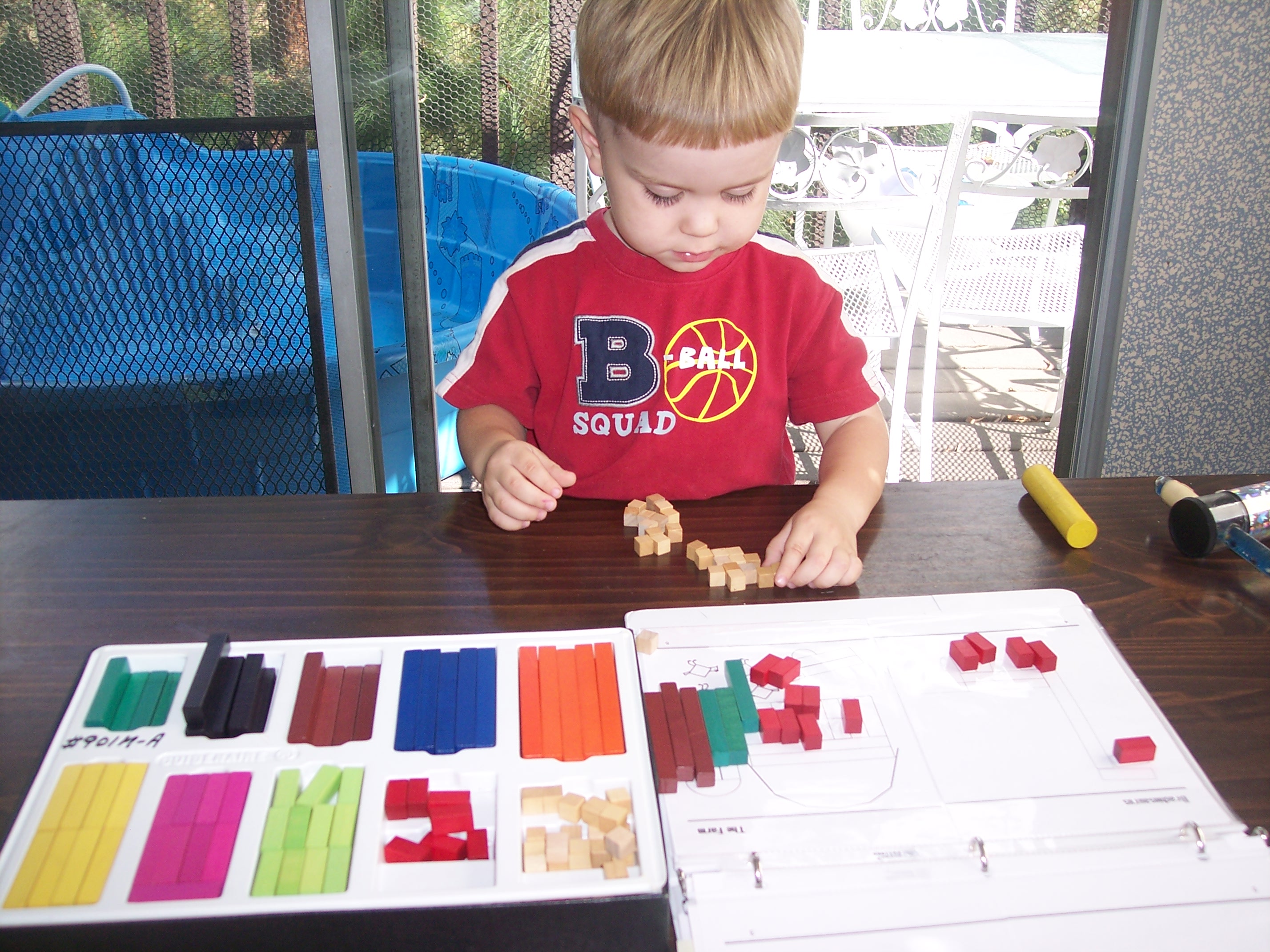
I know there are many homeschool families that hold off on any kind of formal math until the children are around 2nd or 3rd grade, instead using various math games and activities to lay a foundation. At first I considered going this route, but over the last few months something “clicked” in Ian’s brain and he started becoming fascinated by numbers and counting. It felt like a waste not to take advantage of his interest, so I’ve been slowly starting to spend more time on math concepts. As I started this new venture, there were two things I wanted to keep in mind:
- There are many facets of math, so I decided to use a curriculum to make sure I was hitting them all in a logical order.
- I want to be sure to lay a strong foundation of “number sense,” so that Ian is really grasping the concepts behind the symbols we use in math. One of my favorite tools for this is a set of Cuisenaire rods.
 My mom was a teacher, and growing up I used to spend every afternoon in her classroom waiting for her to finish getting things ready for the next day. One of my favorite ways to entertain myself was playing with Cuisenaire rods. There was something so satisfying to me about the way they were designed. When I first became a teacher myself I was blessed with 2 sets of rods, and though I never used them with a large class, I knew they would be a valuable tool in homeschooling. Over the last year I’ve gotten them out several times for the boys to play with, just to build familiarity. As I started looking for a curriculum, I wanted to find one that would incorporate the rods in the early stages. Okay, I have to make a confession. Ian is only 4, but I think I’ve been looking at curricula for at least 2 years. I just like to know what’s out there, to read reviews, talk to other people about what they use, and have a decent idea of what’s available before I need to make a decision. Early on in my search I came across the Miquon Math Lab series. Because I didn’t need them right away, I put them all on my PaperBack Swap wishlist, and within a few months I had collected all 6 workbooks (in order: Orange, Red, Blue, Green, Yellow, and Purple) and the “Lab Sheet Annotations,” which is basically the teacher’s manual. They’ve been sitting on my shelf waiting to get put to use, but I was a little hesitant to start an actual curriculum when Ian is still a few months shy of turning 5. (Most of the books are available very inexpensively at Amazon. You can also get the whole set from Rainbow Resource.) I decided to look online for activities I could do that were more structured than just playing with the blocks,
  but not quite as formal as a curriculum. My favorite resource was the “Cuisenaire Activity and Exploration Book for Pre-Miqon Kids ” by Miranda Hughes, full of activities and games designed for her daughter to use before beginning the Miquon series and generously shared as a free pdf file. I also liked Marcia Miller’s ideas at Unschooling Conversations. There are a number of books available with more ideas, but these free resources will take you a long way (and get you started thinking of your ideas about how to use the rods). I love the “lab” nature of Miquon and these Cuisenaire rod activities, but to me they feel more like a supplement than a core math program (though I know some people have gone that route). So even though I had been hesitant to start a curriculum, I changed my mind and decided to ease into one VERY slowly. There are a number of good math curricula out there, and I think we’d be fine going with pretty much any of them. However, I am all about cheap and convenient, and it’s hard to get cheaper than free or more convenient than having everything you need available online to print whenever you want. That’s why I was drawn to the Mathematics Enhancement Programme (MEP) from the Center for Innovation in Mathematics Teaching in the UK. It’s designed for classroom use but has been used by many homeschool families as well. (There’s even a Yahoo group where you can connect with others using MEP at home.) Incidentally, I know of many families who would chose MEP over other programs even if it weren’t free, so I’m not worried at all about compromising quality just to save some money. From what I understand, the “Reception” year is geared toward preschool-age children, and “Year 1” would be for Kindergarteners. I kept considering starting Reception with Ian, but I was turned off by the format, which is different from the rest of the years. It’s very conversational, which would be okay except that I found so much of the material to be too easy for Ian. I didn’t want to bore him with things he already knew; nor did I want to spend the time picking through everything to find the things he really did need to learn. So I decided to skip Reception and just dive into Year 1. It’s a spiral curriculum so I figure any gaps will be filled in eventually as we move through the program.
  So far Ian is doing fine with the material. We use “Little People” when activities call for using children in the class (they also make great “counters”), and a set of “Thomas & Friends” number cards I found at the 99-Cent Store a while back (though you could easily make your own cards). If you’re interested in using MEP, I highly recommend reading through this post by a mom who’s been using it for a while. Reading this really simplified everything floating around in my mind and encouraged me to give it a shot. Because I spend a lot of time in Charlotte Mason circles, I have to say I feel almost guilty beginning any sort of curriculum with a child so young. However, I am not a slave to any particular method, and Ian seems ready to begin some more structured learning, so here we are. I’m not pushing him to keep up a quick pace. My goal is to get through 2 MEP lessons a week. In the month we’ve been doing this, we’ve sometimes done more, sometimes less, and I’m fine with that. If a concept seems a little challenging for Ian, we spend a little extra time on it before moving on. We’re also taking at least 1 day a week to do some “Math Lab” work. Right now I’m using the pre-Miquon book I mentioned above, but after that we’ll start slowly working our way through The Miquon “Orange Book.” (I’ve torn out the perforated pages and put them in page protectors. Ian can work on them with dry-erase markers and then we can save them to use with the other kids. Yes, the books are cheap, but I just can’t stand the waste of having him write in the book!) There’s one last thing I want to make note of, and that is Elijah’s reaction to all this. He has watched Ian and I doing “Math,” and is eager to have his turn. I try to adapt the lab activities and take a few minutes each session to have some one-on-one time with Elijah. His brain is much more naturally geared toward order and numbers, so his eyes just sparkle with excitement as he does “work.” I have a feeling we’ll be diving into those Cuisenaire activities with him before too long!

I wrote a follow up to this post, so be sure to check that out for more ideas on using Cuisenaire rods.

 The main thing we listened to was Hallelujah Handel by Classical Kids, which tells the story of Handel and an orphan boy. Ian was fascinated by the story, as he has been with all the Classical Kids CDs. They’re really the core of our composer study this year. Here are a few other things we listened to (in order of relative interest to my kids):
 The book Hallelujah Handel tells the same story as the Classical Kids CD, but from a totally different perspective. I enjoyed it just as much, especially the illustrations. Ian and I both enjoyed Handel (from the Famous Children series), and he got a kick out of Handel and the Famous Sword Swallower of Halle, which weaves biographical information around a fascinating incident from Handel’s hometown. When my kids are older, I’d like to read Handel at the Court of Kings by Opal Wheeler, but it looked a little too long for Ian to handle right now. I’d also like to go through Handel (from the Getting to Know the World’s Greatest Composers series) by Mike Venezia
 For the last couple years the boys have enjoyed opening the doors on our


 I’ve mentioned before that we’re also using